


Before a mid-week Champions League match, a bettor checks 3 different Kèo Nhà Cái sources. The first gives a confident pick with no explanation of the reasoning. The second lists odds from a single bookmaker, marked “updated today” with no timestamp. The third shows odds from 4 bookmakers, timestamps the last update, explains the handicap movement since opening, and notes that the analysis was revised after a late squad announcement.
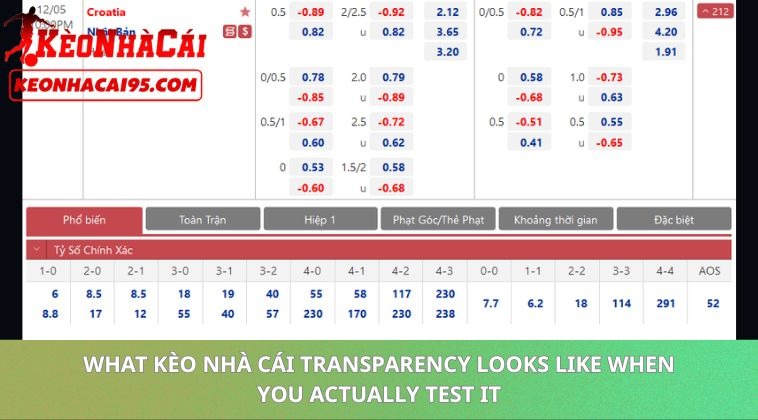
Same fixture. Very different amounts of usable information.
keonhacai95.com is built closer to the third model. The site treats Kèo Nhà Cái coverage as an exercise in presenting what is actually known, when it was known, and what limitations the analysis carries. That’s not a marketing position. It’s an editorial one. And for bettors who have spent time on less transparent sources, the difference becomes visible fairly quickly.
What Professionalism Means in This Context
The word gets used loosely in sports betting. Worth pinning down what it actually implies for a Kèo Nhà Cái analysis operation.
Editorial Separation Between Data and Prediction
A professional approach maintains a clear distinction between what the data shows and what the analyst concludes from it. These are different things. Conflating them produces analysis that sounds authoritative but can’t be independently evaluated.
Take a concrete example. The data might show that a home side has an xG differential of +0.8 per match over the last 8 fixtures, that the Kèo Nhà Cái line opened at -0.5 and has moved to -0.75, and that the opposing side has conceded 1.4 goals per match on the road this season. Those are facts. The conclusion — whether the current line represents good value — is an interpretation that follows from those facts, filtered through assumptions about how much weight each factor deserves.
KEONHACAI95 presents these as separate layers. The underlying numbers appear alongside the interpretive assessment, not buried inside it. Bettors who want to reach their own conclusions from the raw data can do so.
Attribution and Track Record
Kèo nhà cái predictions that appear without attribution are impossible to evaluate. Did this analyst have a positive record over the last 30 fixtures? Or did they start last month with no documented history?
A professionally operated Kèo Nhà Cái portal attaches analysis to named contributors or at minimum to documented editorial processes. It tracks outcomes over time and makes that history accessible rather than selectively presenting good results while burying poor ones.
This matters more than it might seem. An analyst who has been consistently accurate on Asian handicap predictions in La Liga over 6 months deserves more weight than 1 who has been producing content for 3 weeks. The track record doesn’t guarantee future accuracy. It’s simply relevant information.
Transparency — Where It Shows Up and Where It Doesn’t
Honestly, a lot of Kèo Nhà Cái portals use the word without earning it. Transparency that stops at the surface level is actually just better-looking opacity.
Real transparency in this context shows up in a few specific places.
Odds timestamps. If a Kèo Nhà Cái comparison shows odds from multiple bookmakers, when were those odds recorded? A table of odds without timestamps could be 10 minutes old or 6 hours old. In fast-moving pre-match markets, that difference changes the usefulness of the data completely.
Analysis revision notes. When late squad news changes the analytical picture, what happens? A transparent Kèo Nhà Cái portal updates the analysis and notes that a revision was made, and why. A less transparent one leaves the original analysis unchanged or quietly replaces it without acknowledgment.
Expressed uncertainty. This one is underused. An analyst who writes “the handicap line suggests a close match but the sample size for this team’s away performance this season is only 4 fixtures” is giving bettors more useful information than one who presents a confident pick with no qualification. Uncertainty acknowledged is information. It helps bettors calibrate how much weight to put on a given assessment.
(Source: https://keonhacai95.com/ — editorial policy and analysis methodology)
Where Kèo Nhà Cái Analysis Can Go Wrong
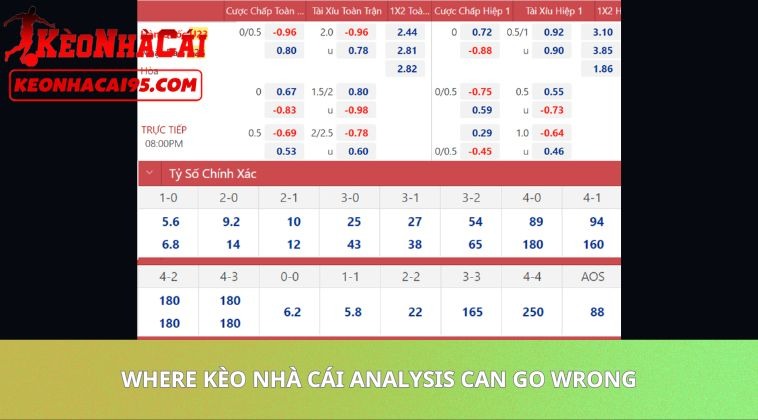
That’s not the whole story though. Even well-intentioned Kèo Nhà Cái analysis carries systematic risks that bettors should understand.
Recency bias. Analysts who have watched a team play badly in recent weeks tend to underweight earlier strong performances. The form data over the last 5 matches feels more vivid than the underlying season-long numbers. This can push Kèo Nhà Cái assessments toward overconfidence in short trends.
Model fitting. When an analytical approach has worked well for a specific type of fixture — home favorites in low-scoring leagues, say — there’s a temptation to apply it universally. Different competition contexts often require different analytical weights. A model calibrated on Premier League data may not transfer cleanly to AFC competition coverage.
Public narrative absorption. Even data-driven analysts read the same football commentary as everyone else. The “conventional wisdom” about a specific team or matchup has a way of appearing in analysis as though it were independently derived. When 9 out of 10 previews share the same conclusion about a Kèo Nhà Cái, it’s worth asking whether they’re independently analyzing the same data or reflecting the same received opinion.
KEONHACAI95 doesn’t claim immunity from these tendencies. What it does is build editorial processes designed to surface and check them before analysis goes to readers.
How a Bettor Actually Uses This
Here’s a realistic scenario. You’re looking at a Serie A fixture on Sunday. You’ve watched this team twice in the last month and have an impression of how they defend. You check the Kèo Nhà Cái at KEONHACAI95 and find that the xG data from the last 8 matches suggests their defensive solidity isn’t quite as strong as what you saw in those 2 specific matches. The analysis also notes that the line has moved 0.25 in favor of the away team since opening, with a note that a key defensive midfielder was confirmed absent 3 hours ago.
Your impression plus the data gives you something to work with. You now have 3 inputs: your own observation, the underlying statistical picture, and the market’s revised assessment after the squad news. None of them independently decides the bet. Together, they make the decision better grounded.
That’s the practical function of a professionally transparent Kèo Nhà Cái portal. Not to replace judgment. To make the inputs to judgment more complete and more honest.
Conclusion
Professionalism and transparency in Kèo Nhà Cái analysis aren’t abstract values. They show up in specific, observable practices: editorial separation between data and interpretation, attributed analysis with documented track records, timestamped odds, revision notes when the picture changes, and honest qualification of uncertainty. KEONHACAI95 applies these practices to its Kèo Nhà Cái coverage not because they’re good marketing but because bettors who engage critically with analysis — rather than following picks blindly — get more value from a portal that can be examined and questioned.


