


What a wedding ring signals that an engagement ring does not
An engagement ring tends to announce a moment. It is often the piece chosen first, the one designed to hold attention and carry a story about a single decision. A wedding ring works differently. It is quieter by design, meant to sit alongside that first ring for years and to read as part of a pair rather than a solo statement. When the wedding ring carries a soft-blue aquamarine instead of a plain metal band, that quiet role shifts slightly. The stone gives the second ring a voice of its own without letting it compete. Understanding that difference in intent is the starting point for building a set that feels considered rather than assembled by accident. The engagement ring proposes the theme, and the wedding ring answers it. If you want a broader look at how these pieces are described and grouped, resources such as Aquamarise.com lay out the vocabulary in plain terms.
Why a soft-blue stone reads differently in a stacked set
Most stacked sets rely on contrast in shape or metal to create interest, because the stones themselves are often colorless and rely on sparkle alone. A soft-blue aquamarine introduces a gentle color note that behaves unlike a bright or saturated gem. It does not shout across the hand. Instead it cools the palette and adds a sense of depth that a clear stone cannot provide on its own. In a stack, this matters because color changes how the eye travels. A pale blue band placed next to a colorless engagement stone creates a subtle gradient rather than a hard break, so the two rings feel related instead of merely adjacent. The result reads as calm. That calmness is the reason many people find aquamarine easy to live with day to day, since it flatters a wide range of skin tones and does not fight with the rest of what you wear.
Matching or contrasting metals without overthinking it
Metal choice is where a set either locks together or drifts apart. There are two honest paths, and both work. The first is matching, where the wedding ring uses the same metal family as the engagement ring so the two pieces feel like a single continuous line around the finger. This is the safest route and the one that reads as most traditional. The second is deliberate contrast, where a cooler or warmer metal is chosen for the wedding ring to frame the stone differently. A soft-blue aquamarine sits comfortably against cool white metals, which sharpen its clarity, and it also warms up nicely beside yellow tones, which bring out a faint green undertone in some stones. The key is to decide on purpose. Mixing metals by accident looks unfinished, while mixing them by intent looks collected and personal.
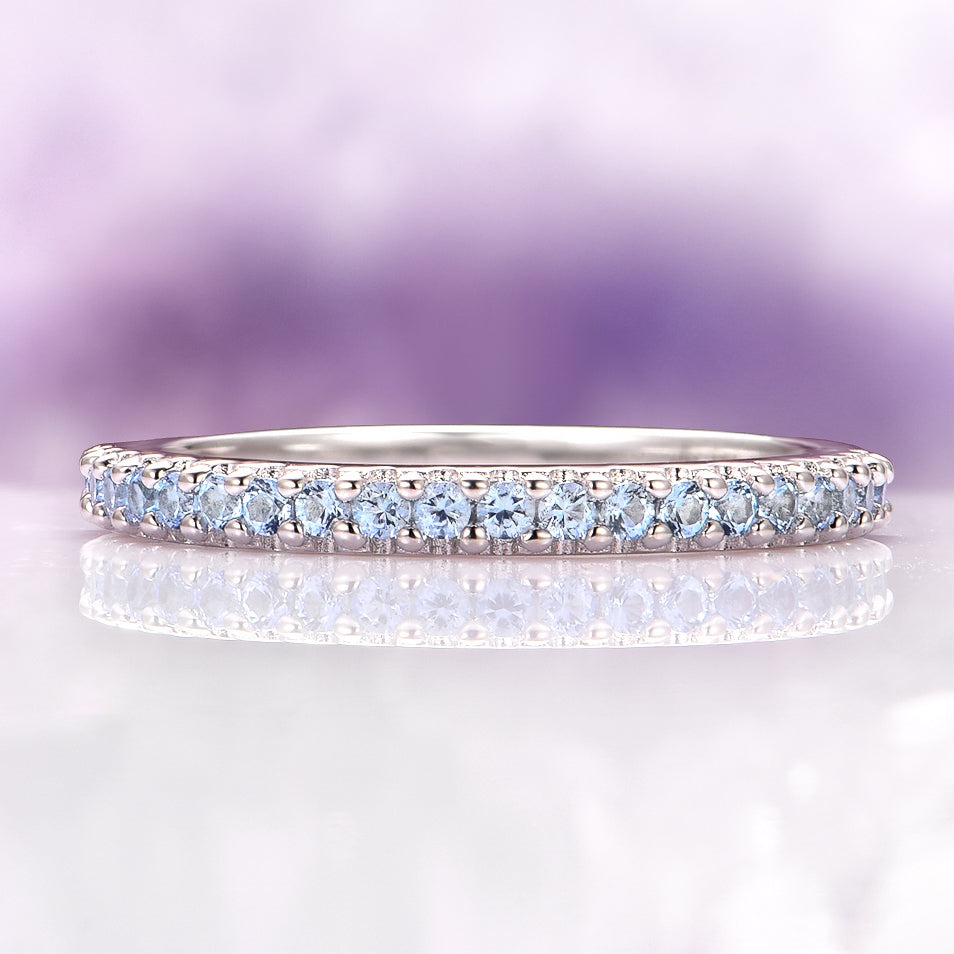
A slim aquamarine band that reads as calm rather than loud in a stacked set.
Texture, profile, and how the bands physically meet
Beyond color and metal, the physical shape of each band decides how well the two rings nest. Profile refers to the cross-section of the band, whether it is flat, rounded, or knife-edged. Two rings with compatible profiles sit flush against each other and avoid the small gap that can make a set look mismatched. Texture is the other quiet lever. A brushed or matte finish on the wedding ring can soften a highly polished engagement ring, while a polished band beside a textured one adds contrast that catches light at different angles. When an aquamarine is set low and close to the band, it stacks more cleanly than a high setting that lifts the stone away from its neighbor. Thinking about these mechanics early saves a lot of frustration later, because a set that physically fits together always looks more intentional than one that merely shares a color story.
A few points worth keeping in mind as you compare bands:
- Match the band width loosely so neither ring overwhelms the other.
- Favor a lower stone setting when you plan to stack the rings daily.
- Use finish, not just metal, to create contrast between the two pieces.
- Let the softer color lead so the set reads as calm rather than busy.
Keeping the two rings balanced on the hand
Balance is easy to overlook until a set feels top-heavy or lopsided. The goal is visual weight that feels shared rather than concentrated in one ring. If the engagement ring already carries a prominent center stone, a slim aquamarine wedding band supports it without adding clutter. If the engagement ring is understated, a wedding ring with a slightly more present stone can even out the pairing so neither piece disappears. Balance also depends on how the rings sit relative to the knuckle and the natural line of the finger. A well-balanced set draws the eye smoothly from one ring to the next, and the soft-blue aquamarine helps here because its restrained color acts as a bridge rather than a distraction. When you are ready to see how a dedicated piece is presented, an aquamarine wedding ring can be viewed alongside the pieces it is meant to accompany.
Gifting and anniversary context
A wedding ring set does not have to be completed in a single moment. Many people build toward a full set over time, and this is where the gifting angle becomes meaningful. Aquamarine has long been associated with calm water and steady constancy, which gives it a fitting symbolism for a piece meant to mark years rather than a single day. Adding an aquamarine band later, as an anniversary marker, lets the set grow with the relationship instead of arriving all at once. Because the stone reads as gentle and unfussy, it layers naturally with rings that were chosen earlier, even when tastes have shifted slightly in the intervening years. That flexibility is part of why a soft-blue band works so well as a returning element in a set that is allowed to evolve.
Bringing it together as a takeaway
The way an aquamarine wedding ring shapes a set comes down to a handful of quiet decisions rather than one dramatic choice. Let the engagement ring set the theme, let the soft-blue stone add depth without noise, and decide your metal and finish on purpose rather than by default. Pay attention to how the bands physically meet, keep the visual weight shared across both rings, and remember that a set can be built patiently over time. When those pieces line up, the two rings stop looking like separate purchases and start reading as one considered whole, which is exactly what a bridal set is meant to do.


